

활용사례
| 제목 | Feasibility Assessment of SAM-Assisted Pseudo-Oriented Bounding Box Generation from Ship Point Annotations in KOMPSAT-3/3A Optical Satellite Imagery | ||
|---|---|---|---|
| 국/내외 | 국내 | 작성일 | 2026-09-14 |
|
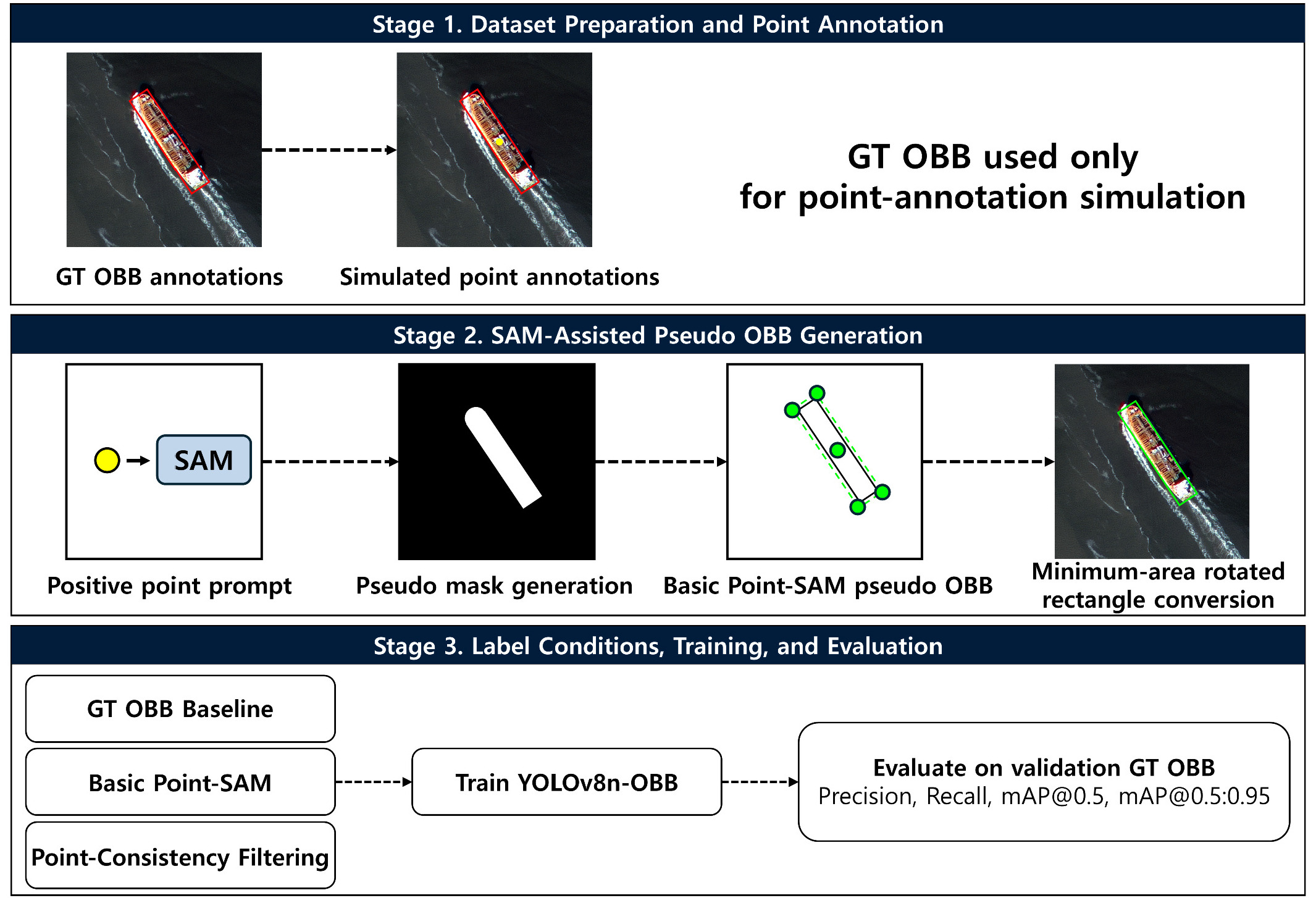
Satellite-image-based ship detection is important for maritime traffic management, search and rescue, illegal fishing surveillance, and maritime security. However, constructing oriented bounding box (OBB) annotations requires manual delineation and verification of object boundaries and orientations, which increases the time and cost required to build large-scale training datasets. Point annotations can provide a lower-cost alternative; however, their applicability to pseudo OBB generation for ships in Korean optical satellite imagery has not been sufficiently investigated. This study evaluated the feasibility of generating pseudo OBBs for ship detection from point annotations using the Segment Anything Model (SAM) and the Korea Multi-Purpose Satellite (KOMPSAT)-3/3A Image-based AI Training Dataset for Ship Detection, developed by the Korea Aerospace Research Institute and released through DataON. The dataset consists of KOMPSAT-3 and KOMPSAT-3A optical satellite imagery, and the original 10 detailed ship categories were integrated into a single ship class for this study. Ground-truth (GT) OBBs were used solely to simulate object-wise point annotations and were not provided directly to SAM. Each point annotation was used as a positive prompt, and the mask generated by SAM was converted into a pseudo OBB using a minimum-area rotated rectangle. Two pseudo-labeling conditions were considered: Basic Point-SAM, which retained valid pseudo OBBs without additional point-relation filtering, and Point-Consistency Filtering, which retained only pseudo OBBs that contained their own source point annotation without including point annotations from other ships. Basic Point-SAM generated pseudo OBBs for 20,699 of 20,964 training objects, corresponding to a success rate of 98.74%. Under a standardized training condition of 300 epochs without early stopping, Point-Consistency Filtering retained 6,911 pseudo OBBs and achieved higher validation mean Average Precision (mAP)@0.5 and mAP@0.5:0.95 values than Basic Point-SAM, improving from 0.348 and 0.185 to 0.452 and 0.259, respectively. A retrospective geometric evaluation showed that the retained pseudo OBBs had substantially higher oriented Intersection over Union (OIoU) values than the removed pseudo OBBs, with mean values of 0.684 and 0.096 and median values of 0.726 and 0.022, respectively. However, ships corresponding to the retained pseudo OBBs were larger and more spatially isolated than those corresponding to the removed pseudo OBBs, indicating a selection bias toward less crowded and relatively easier instances. Therefore, the higher validation performance under the filtering condition should be interpreted as being consistent with training on a smaller but geometrically more reliable subset, rather than as evidence that the point-conflict criterion alone caused the improvement. The proposed approach is more suitable for semi-automatic pre-annotation combined with selective human review than for fully replacing manual OBB annotation. |
|||
| 출처 | https://www.kjrs.org/ | ||
| 이전글 | Radargrammetric 3D Positioning of Pseudo Corner-Reflector Scatterers in KOMPSAT-5 Stacks with Per-Target Conditioning Diagnostics |
|---|---|
| 다음글 | 국토위성 1호 궤도상 운용 현황 및 2호 개발 현황 |
연관위성영상
-
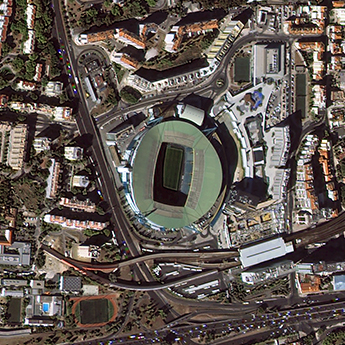 포르투갈:이스타디우 다 루스(2026-10-08)
2026-10-30
-
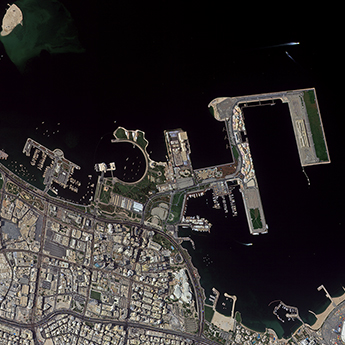 카타르:미아공원(2026-10-07)
2026-10-30
-
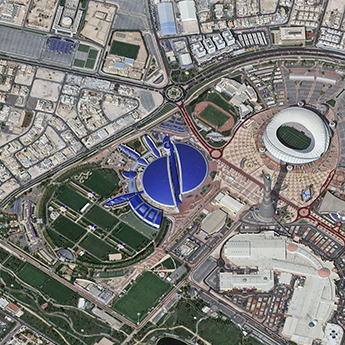 카타르:Aspire Dome(2026-09-06)
2026-09-28
연관활용사례
-
인공위성을 활용한 인공지능 기...
지리
2026-11-10
-
대규모 언어모델(LLM) 기반...
지리
2026-10-19
-
ArcGIS World Ima...
지리
2026-10-12
최신미디어
-
항우연
누리호 5차 발사의 감동...
2026-10-28
-
항우연
대학(원)생 아이디어를 ...
2026-10-23

네팔:지진(2015-05-05)
| 카테고리 | 재난재해 |
|---|---|
| 위성정보 | KOMPSAT-3 |
| 생성일 | 2015-03-24 |
세부정보
| ProductID | K3_20150505073608_15817_06161210 |
|---|---|
| 국가(영문) | Nepal |
| 국가 | 네팔 |
| 지역 | Pokhara |
| 레벨 | 1R |